ゴジラの足跡
 Yuishi
■Title: Traces of Godzilla in Fukushima
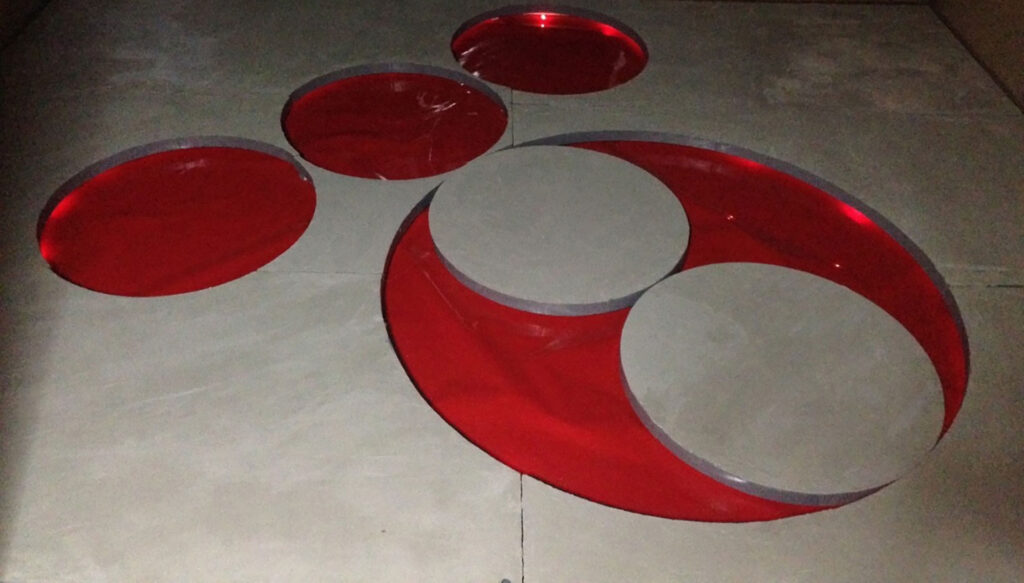
■Title: Traces of Godzilla in Fukushima
■Size: 349cm×285cm
■Material: ウレタンパネル、セメント、塩化ビニールシート、LEDライト
Urethane panels, cement, vinyl chloride sheets, LED lights
■Year: 2016年
■ステートメント
本作品の発表地である大阪府柏原市は、初代『ゴジラ』のプロデューサー、田中友幸の出身地である。 1954年の公開以降、ゴジラは半世紀以上にわたり描かれ続けてきた。 核実験によって誕生し、核エネルギーを内包しながら放射熱線を吐き、都市を破壊し、大きな足跡を残す存在。 それは架空の怪獣として語られてきた。 しかし本当に、ゴジラは“虚構”なのだろうか。 人類は処理技術を持たぬまま核廃棄物を生み出し続け、2011年3月11日、東北地方太平洋沖地震と津波を契機に、福島で大規模な原子力災害を引き起こした。 結果として、帰還困難となった土地が生まれた。 そこに現れた“怪獣”は、確かに痕跡を残している。 大きな円と、五つの小さな円から成る足跡。 一見するとどこか愛らしいその形は、大阪の街においては異物として立ち現れる。 作品前に置かれた黄色いカラーコーンは、その痕跡を現実へと引き戻すための手がかりである。 その足跡が示すもの。 それは、私たちがすでに現実の中で遭遇している“ゴジラ”の正体なのかもしれない。
■Statement
The city of Kashiwara in Osaka Prefecture, where this film was released, is the hometown of Tomoyuki Tanaka, the producer of the original Godzilla. Since its release in 1954, Godzilla has been depicted for over half a century. Born from nuclear testing, it emits a heat ray containing nuclear energy, destroys cities, and leaves behind massive footprints. It has been described as a fictional monster. But is Godzilla truly a "fiction"? Humanity continued to produce nuclear waste without the technology to dispose of it, and on March 11, 2011, the Great East Japan Earthquake and tsunami triggered a massive nuclear disaster in Fukushima. As a result, land became uninhabitable. The "monster" that appeared there certainly left its mark. Footprints consisting of a large circle and five smaller circles. At first glance, its shape seems somewhat endearing, but in the city of Osaka, it stands out as an anomaly. The yellow traffic cones placed in front of the artwork are clues to bring the traces back to reality. What do those footprints reveal? Perhaps it's the true identity of the "Godzilla" we've already encountered in reality.
■Place
柏原市 | 大阪
Kashiwara City | Osaka